
For over a decade, DevOps has transformed how organizations build, deploy, and manage software. By breaking down silos between development and operations teams, DevOps introduced a culture of collaboration, automation, and continuous delivery that significantly accelerated software innovation.
But modern software ecosystems have become far more complex.
Engineering teams now manage microservices, Kubernetes clusters, multi-cloud environments, security compliance frameworks, AI workloads, and increasingly sophisticated CI/CD pipelines. While DevOps helped organizations move faster, many teams are now spending more time managing infrastructure complexity than building business value.
This challenge has given rise to a new discipline: Platform Engineering.
Rather than asking every development team to become infrastructure experts, Platform Engineering creates standardized, self-service platforms that abstract complexity and allow developers to focus on delivering products faster. Industry experts increasingly view Platform Engineering as the natural evolution of DevOps for modern enterprises.
Why DevOps Alone Is No Longer Enough
DevOps successfully solved many problems of traditional software delivery. It improved collaboration, automated deployments, and accelerated release cycles.
However, as organizations scale, new challenges emerge:
Toolchain Complexity
Modern teams often work with:
- Kubernetes
- Terraform
- CI/CD platforms
- Monitoring tools
- Security scanners
- Cloud-native services
- Observability platforms
Managing these tools requires specialized expertise that many product teams simply don’t have.
Developer Productivity Challenges
Developers frequently spend significant time:
- Configuring infrastructure
- Managing deployments
- Understanding cloud services
- Troubleshooting environments
- Handling operational overhead
Instead of building customer-facing features, teams become distracted by platform management tasks.
Scaling Bottlenecks
As companies grow, DevOps teams often become centralized gatekeepers for infrastructure requests, creating delays and reducing engineering velocity. Many organizations discover that “everyone owns everything” becomes difficult to sustain at scale.
What Is Platform Engineering?
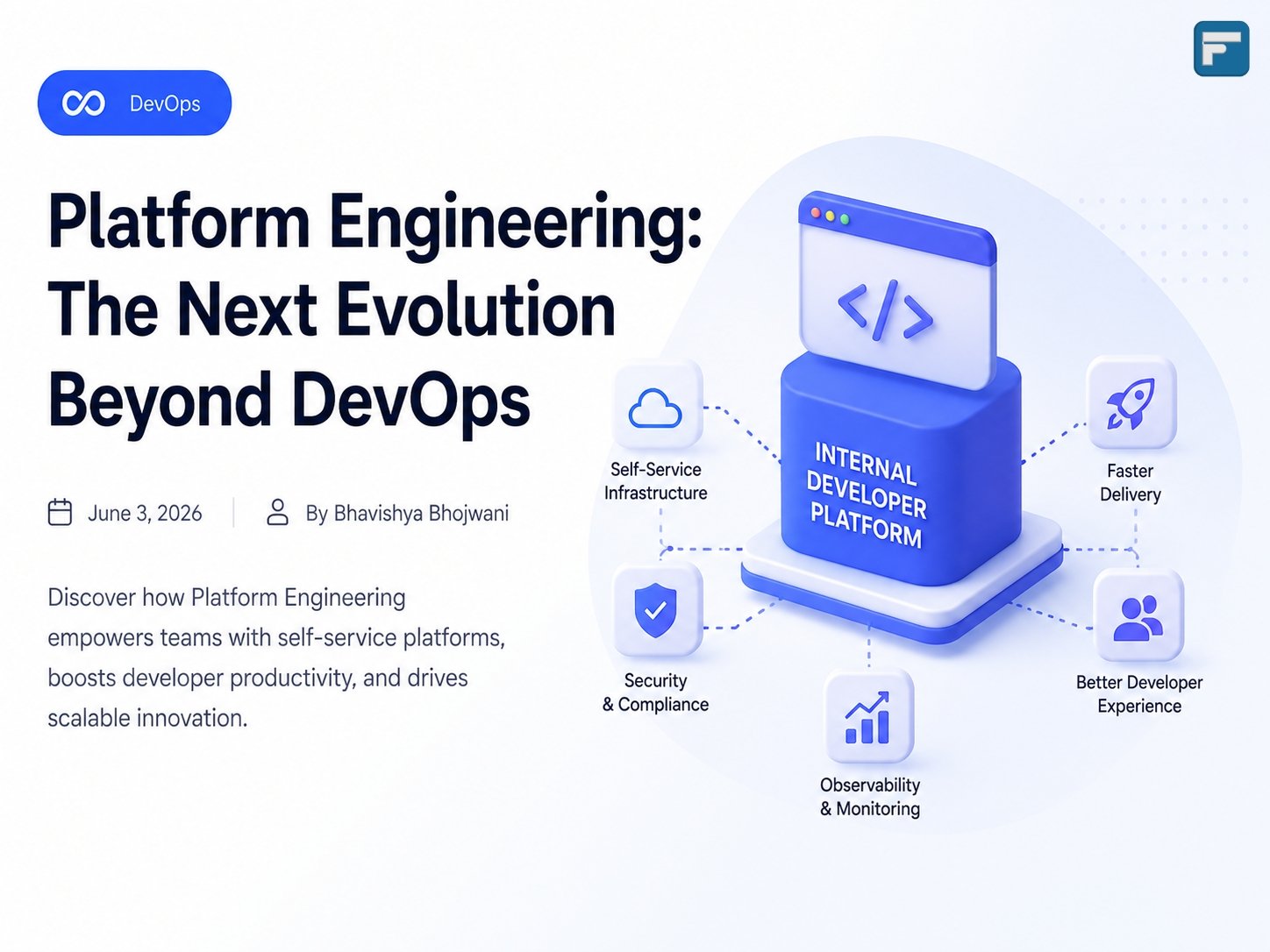
Platform Engineering focuses on building and maintaining Internal Developer Platforms (IDPs) that provide developers with self-service access to infrastructure, deployment pipelines, security controls, and operational tools.
Think of it this way:
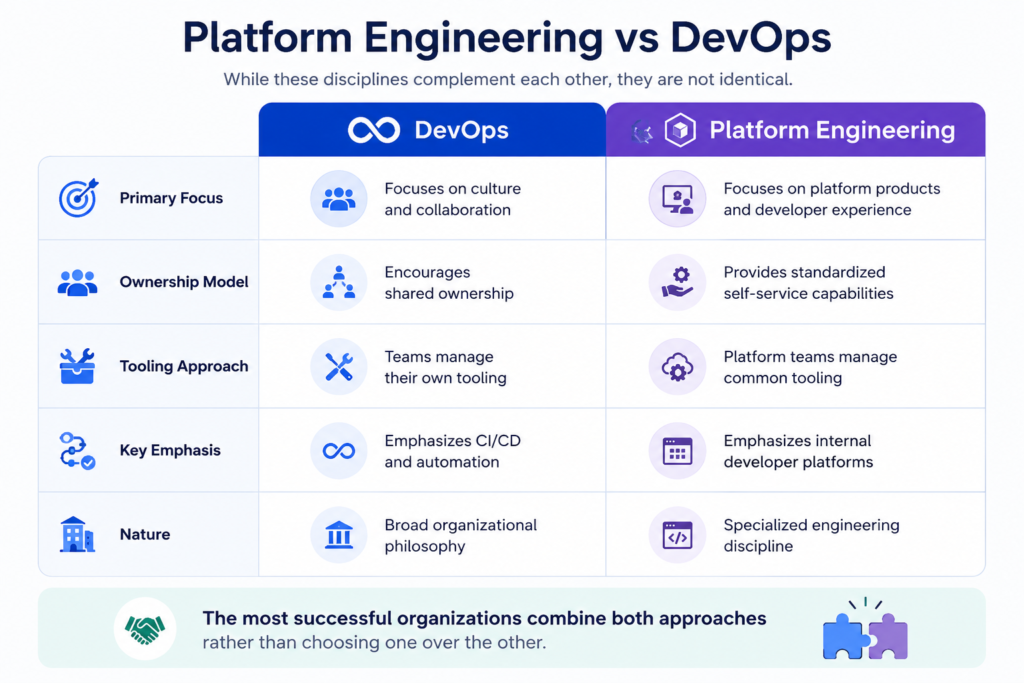
DevOps is a culture and methodology.
Platform Engineering is a product-oriented implementation of that methodology.
Instead of every team reinventing deployment pipelines and infrastructure configurations, a platform team creates reusable building blocks that developers can consume through standardized workflows.
The goal is simple:
Enable developers to deploy, monitor, and scale applications without becoming cloud infrastructure specialists.
The Core Principles of Platform Engineering
1. Self-Service Infrastructure
Developers should be able to provision environments, databases, APIs, and cloud resources without opening tickets or waiting for operations teams.
This reduces bottlenecks and accelerates delivery cycles.
2. Golden Paths
Platform teams create pre-approved templates and workflows that incorporate:
- Security best practices
- Compliance requirements
- Infrastructure standards
- Monitoring integrations
Developers follow proven patterns while maintaining flexibility.
3. Platform as a Product
One of the most important shifts in Platform Engineering is treating internal platforms like customer-facing products.
Platform teams focus on:
- User experience
- Adoption metrics
- Developer satisfaction
- Continuous improvement
Developers become the customers of the platform.
4. Automation First
Everything that can be automated should be automated:
- Infrastructure provisioning
- Security checks
- Compliance validation
- Testing
- Deployments
- Resource optimization
Automation reduces human error and improves consistency.
Key Components of a Modern Internal Developer Platform
A mature platform typically includes:
Developer Portal
A centralized hub where developers can:
- Create services
- Deploy applications
- Access documentation
- Request resources
- Monitor system health
Infrastructure as Code
Infrastructure becomes repeatable, version-controlled, and scalable using tools like Terraform and Kubernetes.
CI/CD Pipelines
Standardized deployment pipelines ensure consistency across teams and projects.
Observability Stack
Integrated monitoring, logging, and tracing help teams quickly identify and resolve issues.
Security Guardrails
Built-in security controls ensure compliance without slowing development velocity.
How AI Is Transforming Platform Engineering
Artificial Intelligence is becoming a major force in platform operations.
Organizations are increasingly using AI to:
- Optimize cloud resource utilization
- Predict infrastructure demand
- Detect anomalies automatically
- Recommend performance improvements
- Generate deployment configurations
- Assist developers with code generation
As AI adoption grows, platform teams are becoming responsible for providing secure, scalable foundations for AI-powered applications and agentic workflows.
Business Benefits of Platform Engineering
Organizations adopting Platform Engineering often experience measurable improvements across multiple areas.
Faster Development Cycles
Developers spend less time managing infrastructure and more time building products.
Improved Developer Experience
Simplified workflows reduce frustration and accelerate onboarding.
Better Security and Compliance
Standardized environments ensure policies are applied consistently.
Reduced Operational Costs
Automation minimizes manual effort and optimizes cloud resource consumption.
Greater Scalability
Engineering teams can grow without proportionally increasing operational overhead.
Common Mistakes Organizations Make
Many Platform Engineering initiatives fail because organizations:
Build for Technology Instead of Users
A platform should solve developer problems – not simply showcase technology.
Over-Engineer the Platform
Complex platforms often create new layers of friction.
Ignore Developer Feedback
Successful platforms evolve based on real-world usage patterns.
Treat Platform Teams as Support Teams
Platform teams should operate like product teams with clear ownership, roadmaps, and success metrics.
The Future of Software Delivery
The future isn’t about replacing DevOps.
It’s about extending its principles through platform-centric thinking.
As cloud environments continue to grow in complexity and AI reshapes software development, organizations need a scalable way to empower developers while maintaining security, reliability, and governance.
Platform Engineering provides that foundation.
Companies that invest in Internal Developer Platforms today are creating the infrastructure necessary for faster innovation, improved developer productivity, and sustainable growth tomorrow. With platform adoption accelerating across enterprises, Platform Engineering is rapidly becoming a strategic capability rather than a technical trend.
Conclusion
DevOps changed how software is delivered. Platform Engineering is changing how software organizations scale.
By building self-service platforms, standardizing workflows, and treating developer experience as a product, organizations can reduce complexity while increasing delivery speed and operational excellence.
For enterprises navigating cloud-native transformation, Platform Engineering is no longer optional – it’s becoming the foundation of modern software innovation.