
Digital transformation has become one of the most talked-about priorities in modern business. Organizations are investing heavily in cloud platforms, AI solutions, automation, data analytics, cybersecurity, and customer experience technologies to stay competitive in an increasingly digital-first world.
Yet there is an uncomfortable reality many leaders face:
A significant percentage of digital transformation initiatives fail to meet their objectives. Research across industries consistently reports that many transformation programs either underperform, exceed budgets, face adoption challenges, or fail to deliver expected business value.
The reason is surprisingly simple.
Most failures are not caused by poor technology choices. They happen because organizations focus on digital tools before addressing strategy, people, processes, and execution.
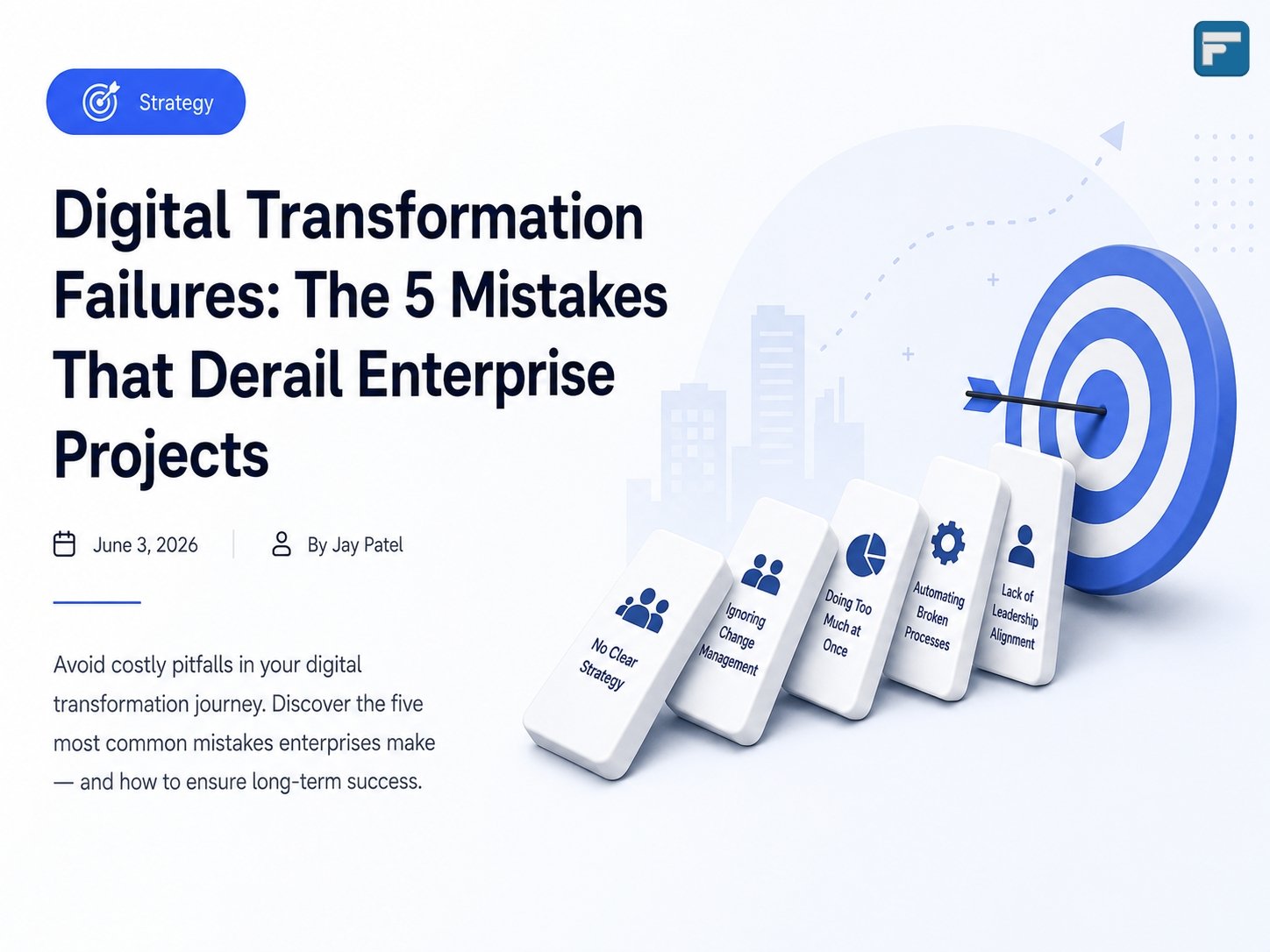
After analyzing common enterprise transformation challenges, five recurring mistakes emerge as the primary causes of failure.
Mistake #1: Starting with Technology Instead of Business Goals
One of the most common transformation mistakes is becoming obsessed with the latest technology trends.
Organizations rush into implementing:
- Artificial Intelligence
- Machine Learning
- Cloud Migration
- Process Automation
- Data Platforms
- Enterprise Applications
without first defining the business problem they are trying to solve.
Technology should never be the starting point.
Successful digital transformation begins by answering critical questions:
- What business outcomes are we targeting?
- Which operational bottlenecks are slowing growth?
- What customer problems need solving?
- How will success be measured?
When organizations skip this stage, they often end up with expensive systems that add complexity without creating measurable value. Multiple studies highlight the lack of strategic alignment as one of the leading causes of transformation failure.
How to Avoid It
Create a transformation roadmap that ties every technology investment to a measurable business objective, such as:
- Revenue growth
- Cost reduction
- Customer retention
- Employee productivity
- Faster decision-making
Technology should support the strategy – not become the strategy.
Mistake #2: Ignoring Change Management and Employee Adoption
Many executives assume that once new technology is deployed, employees will automatically embrace it.
Reality looks very different.
Employees often face:
- New workflows
- New systems
- New responsibilities
- Increased performance expectations
without sufficient training or communication.
As a result:
- Adoption rates decline
- Productivity drops temporarily
- Resistance increases
- Teams revert to old processes
Research consistently identifies user adoption and organizational change management as major factors behind transformation failures.
The biggest challenge in digital transformation is not technology.
It’s human behavior.
How to Avoid It
Organizations should:
- Involve employees early
- Communicate the vision clearly
- Provide continuous training
- Celebrate quick wins
- Create transformation champions across departments
People support what they help create.
Mistake #3: Trying to Transform Everything at Once
Large enterprises often launch transformation programs with ambitious goals:
- Replace legacy systems
- Modernize infrastructure
- Introduce AI
- Redesign processes
- Upgrade customer experiences
all at the same time.
While the vision may be impressive, execution becomes overwhelming.
Large-scale “big bang” transformations frequently create:
- Resource bottlenecks
- Budget overruns
- Project delays
- Operational disruptions
Modern transformation leaders increasingly favor iterative delivery over massive one-time implementations.
How to Avoid It
Adopt an agile transformation approach.
Break initiatives into manageable phases:
Phase 1: Foundation and Assessment
Phase 2: Quick Wins
Phase 3: Process Optimization
Phase 4: Advanced Automation
Phase 5: AI and Innovation
Small successes build momentum and reduce organizational risk.
Mistake #4: Modernizing Technology While Keeping Broken Processes
Many organizations believe digital transformation means digitizing existing workflows.
Unfortunately, automating inefficient processes only makes inefficiency happen faster.
A broken process remains broken – even with modern technology.
For example:
- Manual approval chains
- Duplicate data entry
- Departmental silos
- Poor information flow
cannot be solved by simply implementing new software.
Experts frequently refer to this as the “technology trap,” where organizations automate outdated processes instead of redesigning them.
How to Avoid It
Before implementing technology:
- Map existing workflows.
- Identify bottlenecks.
- Eliminate unnecessary steps.
- Standardize processes.
- Automate only after optimization.
Process transformation should always precede technology transformation.
Mistake #5: Lack of Executive Alignment and Ownership
Digital transformation cannot be delegated entirely to the IT department.
Yet this remains one of the most common mistakes in enterprise environments.
When leadership teams are not aligned:
- Priorities conflict
- Budgets become fragmented
- Departments work independently
- Decision-making slows
Employees receive mixed signals about the importance of transformation.
Research repeatedly points to weak executive sponsorship and leadership alignment as major barriers to transformation success.
How to Avoid It
Transformation initiatives should be sponsored by executive leadership and treated as a company-wide business strategy.
Successful organizations establish:
- Executive steering committees
- Cross-functional governance teams
- Shared KPIs
- Regular progress reviews
- Accountability frameworks
Digital transformation is a leadership initiative first and a technology initiative second.
A Framework for Successful Digital Transformation
Organizations that consistently succeed with transformation initiatives follow a simple but powerful framework:
1. Start with Business Outcomes
Focus on measurable objectives before selecting technology.
2. Prioritize People
Invest in training, communication, and change management.
3. Deliver Incrementally
Avoid large-scale disruptions by implementing changes in phases.
4. Optimize Processes First
Redesign workflows before automating them.
5. Establish Strong Governance
Ensure executive sponsorship and organization-wide accountability.
When these principles work together, transformation becomes sustainable rather than disruptive.
The Future of Digital Transformation
As AI, automation, cloud-native platforms, and advanced analytics continue to evolve, digital transformation will become even more critical for enterprise success.
However, future winners will not necessarily be the organizations with the most advanced technology.
They will be the organizations that successfully align technology, people, processes, and strategy.
The companies that treat transformation as an ongoing business capability – not a one-time project – will be best positioned to innovate, adapt, and grow in an increasingly digital economy.
Final Thoughts
Digital transformation failure is rarely about choosing the wrong software or cloud provider.
More often, it stems from strategic misalignment, poor change management, unrealistic execution plans, inefficient processes, and a lack of leadership commitment.
Technology can accelerate growth, improve efficiency, and unlock innovation- but only when supported by the right foundation.
Organizations that avoid these five mistakes dramatically increase their chances of turning transformation investments into measurable business outcomes and long-term competitive advantage.