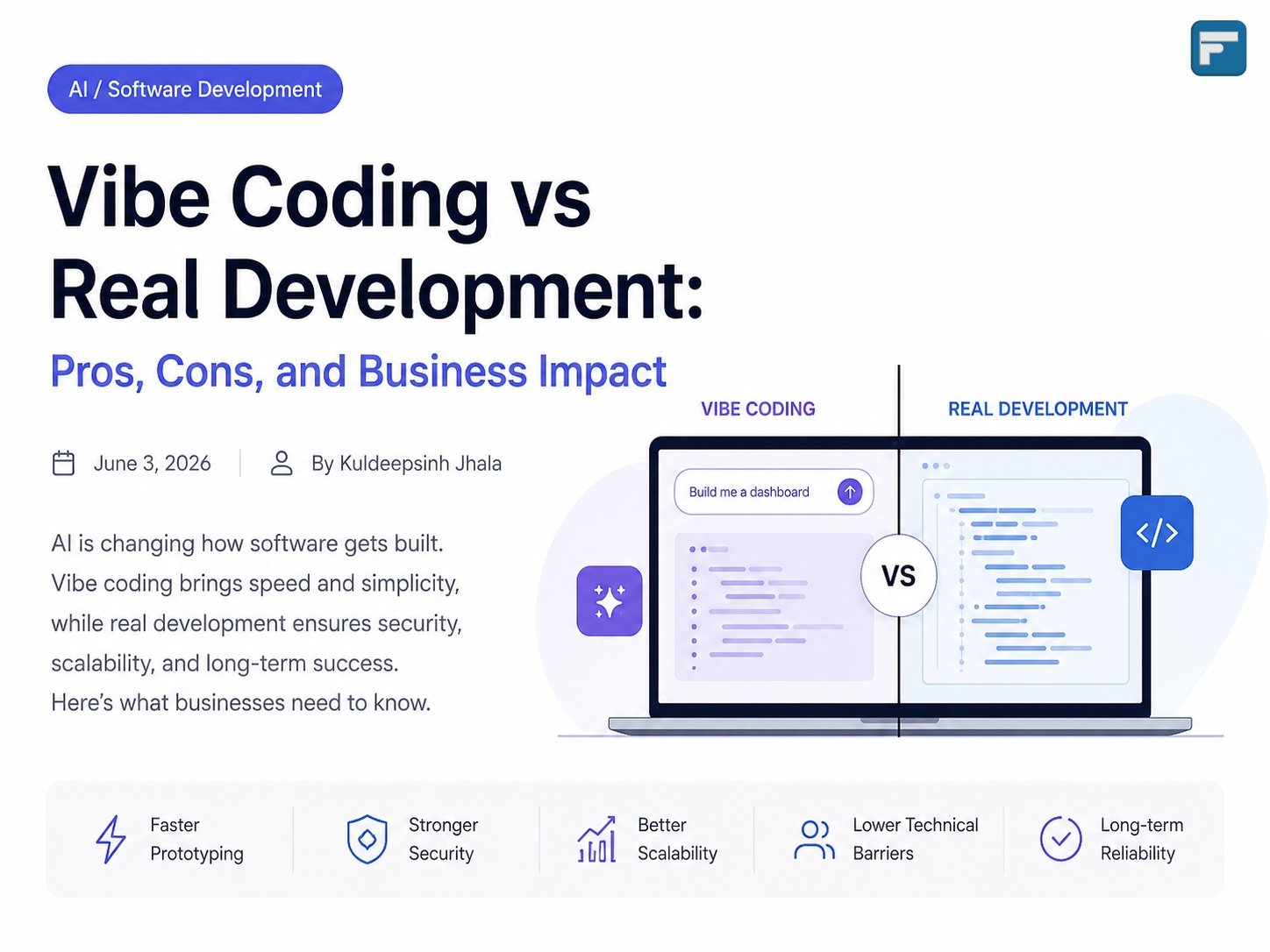
Software development has entered a new era.
Just a few years ago, building an application required extensive coding knowledge, development frameworks, testing processes, and deployment expertise. Today, AI-powered tools can generate functional applications from a simple prompt like:
“Build me a customer dashboard with authentication and analytics.”
This emerging approach is commonly known as Vibe Coding – a development style where users describe what they want in natural language, and AI generates most of the code. The term has gained significant traction as AI coding tools become increasingly capable of creating websites, applications, APIs, and workflows with minimal human intervention.
But does this mean traditional software engineering is becoming obsolete?
Not quite.
While vibe coding excels at speed and experimentation, real software development remains essential for building reliable, secure, scalable, and maintainable systems. Understanding the distinction is becoming increasingly important for startups, enterprises, and technology leaders making strategic decisions about product development.
What is Vibe Coding?
Vibe coding is an AI-assisted development approach where users communicate desired outcomes in natural language and allow AI systems to generate the implementation code. Instead of manually writing every component, function, or API integration, developers guide the AI through prompts and iterative feedback.
A typical vibe coding workflow looks like this:
- Describe the feature or application.
- AI generates code.
- Run and test the output.
- Ask AI to modify or fix issues.
- Repeat until the desired result is achieved.
This dramatically lowers the barrier to entry for software creation and enables faster prototyping than traditional development methods.
What is Real Software Development?
Real software development goes far beyond writing code.
It involves a structured engineering process that includes:
- Business requirement analysis
- System architecture design
- Database modeling
- Security planning
- Performance optimization
- Automated testing
- DevOps and deployment
- Monitoring and maintenance
- Documentation and governance
Professional development teams focus not only on making software work today but ensuring it continues to work reliably years from now.
The goal isn’t simply to generate code.
The goal is to build sustainable systems that support business growth.
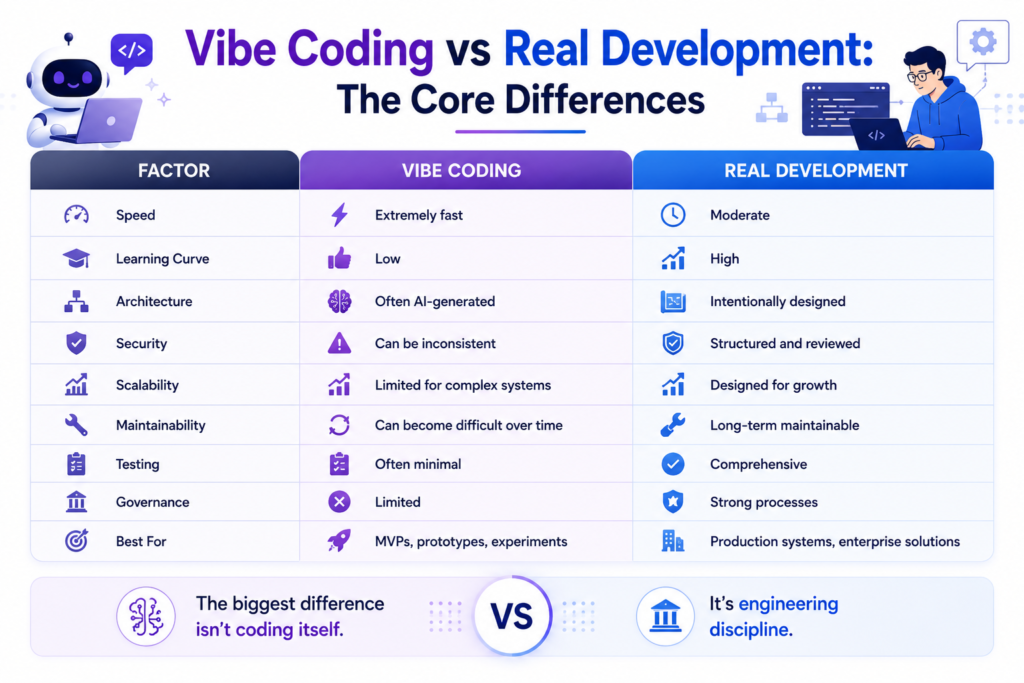
Advantages of Vibe Coding
1. Rapid Prototyping
Perhaps the biggest advantage is speed.
Ideas that previously required weeks of development can now be transformed into working prototypes within hours.
For startups validating concepts, this can be a significant competitive advantage.
2. Lower Technical Barriers
Non-developers can now participate in software creation.
Product managers, founders, marketers, and business analysts can quickly test ideas without waiting for full engineering cycles. Researchers have highlighted how vibe coding is expanding access to software creation for users with varying technical backgrounds.
3. Increased Developer Productivity
Experienced developers are also benefiting.
AI can automate repetitive coding tasks, generate boilerplate code, create documentation, and accelerate debugging efforts.
This allows engineers to focus on solving higher-value business problems.
4. Faster Experimentation
Organizations can test multiple concepts before committing resources to full-scale development.
This reduces risk during product discovery and innovation phases.
The Hidden Risks of Vibe Coding
While the advantages are compelling, there are important limitations businesses must understand.
1. Security Vulnerabilities
AI-generated code can introduce security flaws that are not immediately obvious.
Several industry analyses warn that AI-produced code may contain vulnerabilities and requires rigorous review before production use.
Without security expertise, organizations may unknowingly deploy risky applications.
2. Lack of Architecture
AI is excellent at generating features.
It is less reliable at designing long-term system architecture.
As applications grow, teams often discover that quick AI-generated solutions become increasingly difficult to maintain.
3. Technical Debt
Fast development frequently creates hidden complexity.
Applications built entirely through prompts can become “black box” systems where nobody fully understands the underlying implementation. Researchers identify maintainability and understanding of AI-generated code as a growing challenge.
4. Scalability Challenges
A simple application serving 100 users is very different from a platform supporting 100,000 users.
Enterprise-grade scalability requires intentional architectural decisions, infrastructure planning, and performance optimization.
These areas still rely heavily on experienced engineers.
5. Compliance and Governance Risks
Industries such as healthcare, finance, insurance, and government operate under strict regulatory requirements.
AI-generated software may not automatically meet compliance standards without human oversight and validation.
Where Real Development Still Wins
Traditional software engineering continues to dominate in several critical areas.
Enterprise Applications
Large organizations require:
- High availability
- Disaster recovery
- Security controls
- Regulatory compliance
- Auditability
These requirements demand structured engineering processes.
Complex Integrations
Modern businesses depend on interconnected systems:
- ERP platforms
- CRM systems
- Data warehouses
- Third-party APIs
- Cloud infrastructure
Successfully integrating these systems requires deep technical expertise.
Long-Term Products
Software products intended to evolve for years need:
- Clean architecture
- Testing frameworks
- Documentation
- Version control strategies
- Performance optimization
These elements remain difficult to achieve through prompting alone.
The Future Isn’t Vibe Coding vs Development
The real future is Vibe Coding + Engineering.
Many organizations are already adopting hybrid workflows where:
- AI accelerates implementation.
- Engineers validate architecture.
- Security teams review risks.
- QA teams verify quality.
- DevOps teams ensure reliability.
This approach combines the speed of AI with the discipline of software engineering.
Industry experts increasingly view AI-assisted development as a productivity multiplier rather than a replacement for engineering expertise.
Business Impact: What Leaders Should Consider
For business leaders, the key question isn’t:
“Should we use AI for development?”
The better question is:
“Where does AI create value without introducing unacceptable risk?”
A practical framework looks like this:
Use Vibe Coding For:
- MVPs
- Internal tools
- Proof-of-concepts
- Process automation
- Rapid experimentation
Use Real Development For:
- Customer-facing platforms
- Enterprise applications
- Financial systems
- Healthcare solutions
- High-scale SaaS products
- Mission-critical infrastructure
Organizations that find the right balance can reduce development timelines while maintaining software quality and reliability.
Final Thoughts
Vibe coding represents one of the most exciting shifts in software development since the rise of cloud computing.
It democratizes software creation, accelerates innovation, and enables teams to move from idea to prototype faster than ever before.
However, building software is only part of the challenge.
Creating secure, scalable, maintainable, and business-critical systems still requires experienced engineers, sound architecture, and disciplined development practices.
The most successful organizations won’t choose between vibe coding and real development.
They’ll leverage both.
AI will help teams build faster.
Engineering expertise will ensure they build the right way.
And together, they will define the future of software development.