Cybersecurity has entered a new era.
Traditional security models were built around a simple assumption: everything inside the corporate network could be trusted. Firewalls protected the perimeter, employees worked from office locations, and critical systems lived within company-controlled data centers.
That world no longer exists.
Today, employees access applications from anywhere, workloads run across multiple cloud providers, partners require system access, and AI-powered tools exchange sensitive information continuously. The traditional network perimeter has effectively disappeared.
This shift has made one thing clear: trust can no longer be granted simply because a user or device is inside a network.
This is where Zero Trust comes in.
Yet despite its growing popularity, many businesses still misunderstand it. Vendors frequently market “Zero Trust products,” creating the impression that purchasing a security solution automatically makes an organization Zero Trust compliant.
The truth is much more nuanced.
Zero Trust is not a product you buy. It’s an architectural mindset you adopt.
What Is Zero Trust?
Zero Trust is a cybersecurity framework based on a simple principle:
Never trust. Always verify.
Instead of automatically trusting users, devices, or applications, every access request must be continuously authenticated, authorized, and validated before access is granted.
Whether the request originates from inside the corporate network, a home office, or a cloud environment, the same verification standards apply.
This philosophy assumes that breaches are possible and focuses on minimizing their impact through continuous validation and least-privilege access.
Why Traditional Security Models Are Failing
For years, organizations relied on perimeter-based security.
The approach looked something like this:
- Build strong firewalls.
- Secure the network boundary.
- Trust users once they’re inside.
While this model worked reasonably well in centralized environments, modern digital ecosystems have changed the game.
Today’s businesses operate with:
- Remote and hybrid workforces
- Cloud-native applications
- Multi-cloud environments
- Third-party integrations
- Mobile devices
- AI-powered workflows
- Internet of Things (IoT) systems
Each of these introduces new attack surfaces that perimeter security alone cannot adequately protect.
Cybercriminals understand this reality and increasingly focus on credential theft, insider threats, and identity-based attacks rather than attempting to breach firewalls directly.
As a result, organizations need a security strategy that protects resources wherever they exist.
The Core Principles of Zero Trust Architecture
A successful Zero Trust strategy is built on several foundational principles.
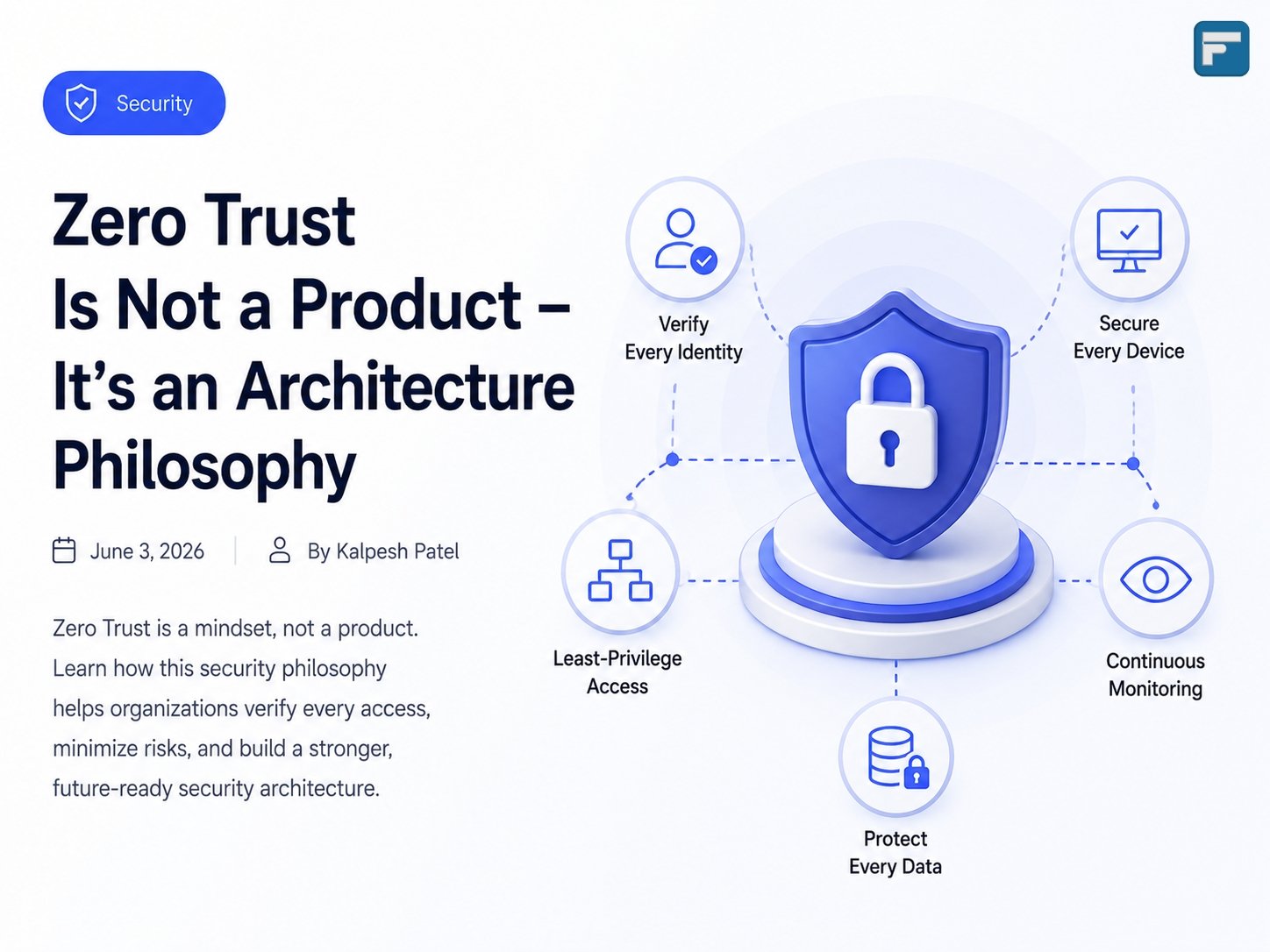
1. Verify Every Identity
Every user, application, and device must prove who they are before accessing resources.
Modern organizations typically implement:
- Multi-factor authentication (MFA)
- Single Sign-On (SSO)
- Identity and Access Management (IAM)
- Adaptive authentication
Identity becomes the new security perimeter.
2. Enforce Least-Privilege Access
Users should receive only the permissions necessary to perform their jobs.
This limits damage if credentials are compromised.
For example:
A marketing employee should not have unrestricted access to financial systems.
A contractor should not retain access after a project ends.
An AI model should only access approved datasets.
The goal is simple: reduce unnecessary exposure.
3. Continuously Monitor Activity
Verification doesn’t stop after login.
Zero Trust continuously evaluates:
- User behavior
- Device health
- Access patterns
- Geographic location
- Risk indicators
If unusual behavior is detected, access can be restricted or revoked automatically.
4. Assume Breach
One of Zero Trust’s most important concepts is the assumption that attackers may already be inside the environment.
Rather than focusing solely on prevention, organizations prepare to:
- Detect threats quickly
- Contain attacks rapidly
- Limit lateral movement
- Reduce business impact
This mindset significantly improves cyber resilience.
Key Components of a Modern Zero Trust Architecture
A mature Zero Trust environment typically includes multiple layers of protection.
Identity Security
Identity serves as the primary control layer.
Key technologies include:
- MFA
- Privileged Access Management (PAM)
- Identity Governance
- Conditional Access Policies
Device Security
Every device requesting access must meet security requirements.
This often includes:
- Endpoint Detection and Response (EDR)
- Mobile Device Management (MDM)
- Device compliance monitoring
- Endpoint risk assessment
Network Segmentation
Rather than providing broad network access, Zero Trust divides environments into smaller protected zones.
Benefits include:
- Reduced attack spread
- Improved visibility
- Better policy enforcement
Micro-segmentation has become a critical component of modern security architecture.
Data Protection
Protecting sensitive information is equally important.
Organizations implement:
- Data classification
- Encryption
- Data Loss Prevention (DLP)
- Access monitoring
Security should follow the data itself – not just the systems that store it.
Common Myths About Zero Trust
Myth #1: Zero Trust Requires Replacing Existing Infrastructure
Not true.
Most organizations adopt Zero Trust gradually by enhancing existing security controls rather than replacing them entirely.
Myth #2: Zero Trust Slows Productivity
When implemented correctly, the opposite is often true.
Modern authentication systems can improve user experiences while maintaining stronger security controls.
Myth #3: Zero Trust Is Only for Large Enterprises
Small and mid-sized organizations face many of the same threats as global enterprises.
Zero Trust principles can be scaled to organizations of any size.
How AI Is Changing Zero Trust in 2026
Artificial Intelligence is reshaping cybersecurity at an unprecedented pace.
AI is helping organizations:
- Detect anomalous behavior faster
- Automate threat response
- Improve risk scoring
- Analyze massive security datasets
At the same time, attackers are also leveraging AI to launch more sophisticated phishing campaigns, credential attacks, and social engineering attempts.
This dynamic makes continuous verification even more important.
Zero Trust and AI are increasingly becoming complementary strategies rather than separate initiatives.
A Practical Roadmap for Zero Trust Adoption
Organizations looking to embrace Zero Trust should focus on a phased approach:
Phase 1: Assess Current Security Posture
Identify:
- Critical assets
- User access patterns
- Existing security gaps
- High-risk systems
Phase 2: Strengthen Identity Controls
Prioritize:
- MFA implementation
- Identity governance
- Access reviews
- Privileged account management
Phase 3: Improve Visibility
Deploy monitoring solutions that provide insight into:
- Users
- Devices
- Applications
- Data access patterns
Phase 4: Implement Segmentation
Reduce unnecessary trust relationships by limiting access between systems and workloads.
Phase 5: Automate Security Decisions
Use policy-driven automation and AI-powered analytics to respond to threats faster and more consistently.
The Future of Security Is Built on Trust Verification
The cybersecurity landscape continues to evolve rapidly.
Cloud adoption, remote work, AI, and digital transformation initiatives have fundamentally changed how organizations operate. Security strategies must evolve as well.
Zero Trust offers a practical response to this reality by shifting the focus from location-based trust to continuous verification. Rather than assuming users and devices are safe, organizations validate every interaction and minimize risk through intelligent access controls.
The companies that thrive in 2026 won’t necessarily be the ones with the largest security budgets—they’ll be the ones that build security into every layer of their architecture.
Because in today’s world, trust isn’t something you grant once.
It’s something you verify continuously.